
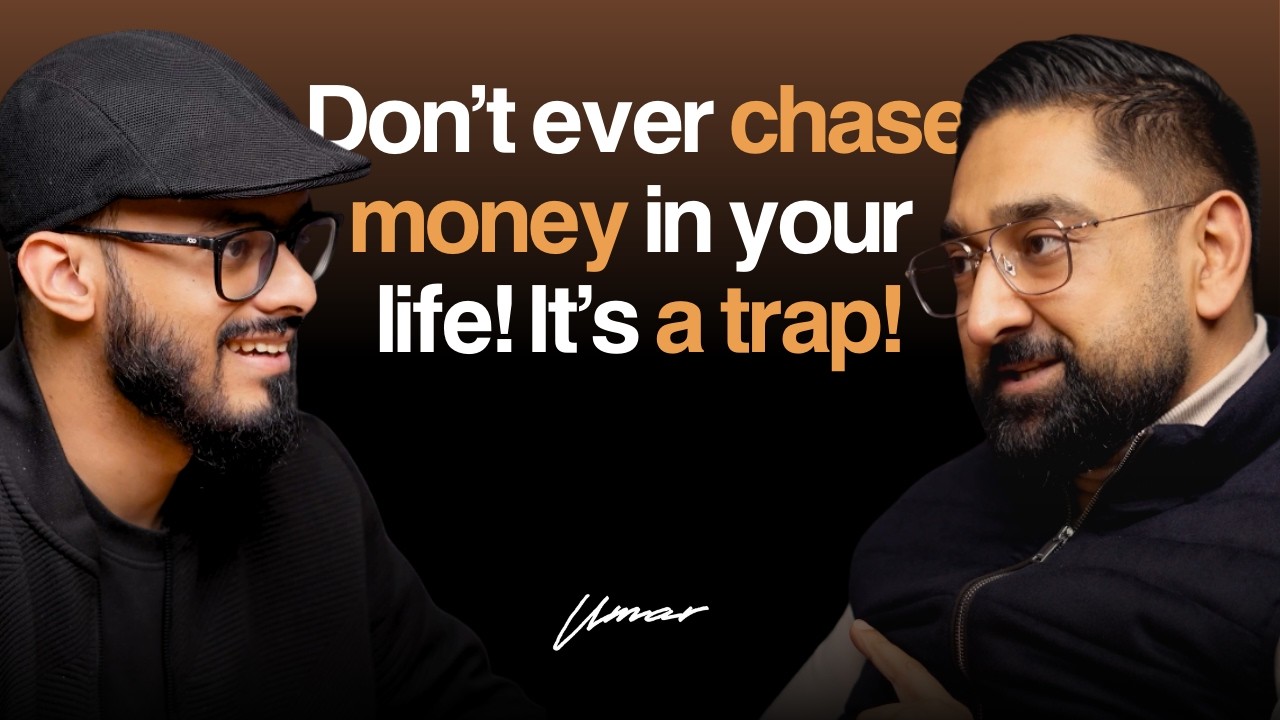
Old Gold vs New Age: What Founders Get Wrong About Money & Success
with Sameer Yoonus — Entrepreneur & Cricket Commentator
Umar sits down with his friend of more than 16 years for an "old gold vs. new age" conversation that goes far beyond business — migration and belonging, raising kids who don't know where home is, escaping the social media algorithm that rewires your priorities every single day, and the Islamic principle of moderation: the good deed that always sits between two extremes.
Key takeaways
- 01
Wisdom is knowing what to keep from the old and what to take from the new.
- 02
Success without intention is just motion.
- 03
Your priorities are being rewired daily — choose the inputs before they choose you.
- 04
Moderation is not the middle of weakness; it is the balance point of strength.
Show Notes
In this conversation
- 01
What to keep from the old generation — and what to leave behind
- 02
Migration and belonging: leaving Sri Lanka in the 2022 exodus
- 03
Raising kids who don't know where home is
- 04
Escaping the social media algorithm that rewires your priorities daily
- 05
Entrepreneurship, faith and money across two generations
- 06
The Islamic principle of moderation — the good deed between two extremes
The Summary
The conversation, distilled
There is something quietly poignant about watching two old friends finally sit down in front of a microphone after years of meaning to. Umar Yoosuf and Sameer Yoonus have known each other for over sixteen years — from organizing lectures and events back in Sri Lanka, through becoming business partners and neighbors in Dubai — and the ease of that history is present in every exchange. Sameer, now on the cusp of returning to Sri Lanka after nearly four years in the UAE, arrives at this conversation in a reflective mood: a man who came to Dubai not out of economic desperation but out of a desire to escape the grinding uncertainty of the 2022 crisis back home, and who found that the city rewired him in ways he is still processing. He describes the UAE as a place that does not feel like a single country but like an entire world compressed into one — a melting pot where watching so many different cultures operate side by side dismantled the tunnel vision that, as he puts it, naturally comes with growing up on a small island nation where everyone tends to paint life in the same mold.
The conversation turns early and honestly to the emotional arithmetic of living abroad. Umar raises something that clearly sits with him: if you spend only twenty or thirty days a year back home, and your parents are growing older, the cumulative time you will share with them over a decade amounts to just a few months of physical presence. No video call, both men agree, can replicate that. Sameer is frank about his own mixed feelings — he is genuinely excited to return, to be closer to his mother, to breathe at a slower pace — but he is also candid that four years in the UAE have instilled a restlessness he cannot simply switch off. Even in his current sabbatical, he wakes up asking himself why he is not building something. He is equally clear-eyed about the privilege in his position: his Sri Lankan business is already connected to the company he worked for in the Gulf, which means his return carries a foundation that most departing immigrants simply do not have. For those without that foundation, he acknowledges, the calculus is different — many are making sacrifices today so their children inherit a stronger passport, a wider horizon, even if the parents themselves never fully reap the benefit of that document.
The episode then moves into its central intellectual territory: what founders and working professionals get wrong when they treat the old generation and the new generation as entirely separate instruction manuals. Sameer draws on his vantage point — late thirties, raised in a traditional textile trading family, now operating inside a Belgian-owned furnishing fabric group — to argue that both camps carry something the other genuinely needs. He offers his father as the clearest illustration of this tension. His father never held a bank account in his life, reasoning with perfect internal logic that he should not have to queue to access his own money. That worked in its time and cannot work now, Sameer says plainly. But the same father also held an absolute rule against buying anything on installment — if you cannot pay for it in full, you do not buy it. That principle, Sameer says, he will carry to his deathbed. He and his brother apply it to their personal lives to this day, and he sees its absence as one of the defining financial disorders of the younger generation: swiping credit cards for things they do not need, to impress people they do not particularly like, arriving at the end of each month with a salary already eaten by monthly commitments before it is even seen.
The discussion of loyalty and commitment in the workplace produces one of the episode's more striking details. Sameer describes arriving at Fabric Library in Dubai and discovering that several members of the team had worked for the predecessor company, Silkland, for over thirty years. He recalls his disbelief, and then the story that followed: the Danube Group — one of the UAE's most prominent retail conglomerates — heard about this staff retention and sent their own HR team to learn from it. Sameer holds this up as something genuinely admirable while refusing to romanticize it uncritically. He notes that some of those employees spent decades separated from their families in India, returning home for only a month or two each year. The loyalty was real, but it was also born partly from necessity. His more pointed observation is directed at business owners: loyalty of that depth deserves to be noticed and rewarded, and if it is not — if a person has given fifteen or twenty years and is still treated as a replaceable number — then something has gone badly wrong on the employer's side of the equation.
Where the conversation finds its sharpest edge is in the diagnosis of the younger generation's relationship with focus. Both men are sympathetic rather than dismissive, and they locate the root of the problem precisely: the older generation made its life decisions largely in response to scarcity of information — newspapers, a single television channel, the visible reality of World War II and economic hardship — which produced a certain clarity of purpose. Today's young person is instead swimming in an algorithmically curated abundance of other people's highlight reels, and the result is a kind of perpetual repositioning. Sameer describes watching his own feed shift after a half-hour conversation with a friend who runs a car showroom in Ajman — suddenly every influencer on his phone is explaining how to import vehicles from the United States for a twenty-thousand-dollar profit. He is honest enough to say this is not only a young person's problem; it afflicts everyone who consumes without discernment. The antidote both men arrive at is not nostalgia for the old way but something more deliberate: pick one thing, develop genuine mastery in it, resist the pull of diversification until that foundation is solid, and understand that the constant switching is not ambition — it is distraction wearing ambition's clothes. As Sameer puts it, even in Islamic teaching the principle holds: every good virtue lives between two extremes, and moderation is not a compromise but the destination itself.
Resources
Links & mentions
About the Guest
Sameer Yoonus
Entrepreneur & Cricket Commentator
Sameer Yoonus has spent his life standing between two worlds. Born and raised in Sri Lanka, he moved to Dubai in the 2022 exodus, built a career in the fabric and furnishing industry, became a cricket commentator covering international leagues — and is now preparing to move back home. Old enough to carry his father's principles, young enough to live on social media.
Keep Listening
More episodes


Sponsor the Podcast
Reach thoughtful founders, builders and ambitious young professionals.
North House listeners are people building things that matter. If your brand belongs in that conversation, let's talk.
Sponsor the podcast